
 349,500 Certificates Issued
 24/7 Online Course
 Money Back Guarantee
 Fully Accredited Course

Confined space course online from Ireland Safety Training - Ireland's trusted provider of accredited confined space training. Complete your confined spaces course in 45 minutes, receive your certificate instantly, and demonstrate awareness-level competence in confined space safety. CPD certified, RoSPA approved, compliant with S.I. No. 218 of 2001. Trusted by 350,000+ learners across Dublin and Ireland. Only €35 (Final Price).
Start Confined Space Course - €35 (Final Price)This confined space training course covers hazard identification, risk assessment, atmospheric monitoring principles, safe systems of work, emergency rescue awareness, PPE requirements, and Irish legislation including the Safety, Health and Welfare at Work (Confined Spaces) Regulations 2001 (S.I. No. 218 of 2001). Designed for workers, supervisors, and managers across construction, utilities, manufacturing, agriculture, and all industries where confined spaces are present.
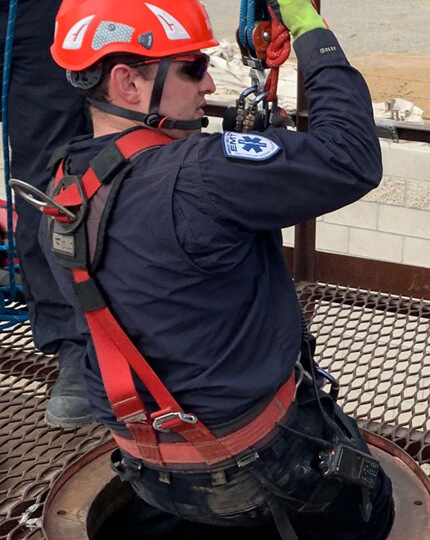
Our confined spaces course covers all essential awareness-level topics required for understanding confined space risks, Irish legislation, and safe systems of work. Earn your confined space certificate upon completion.
This confined spaces training is essential for anyone who works in, near, or supervises work in confined spaces across Ireland. Available online from Dublin, Cork, Galway, Limerick, Waterford, Belfast, Kilkenny, Drogheda, Wexford, Sligo, and nationwide.
Site workers entering manholes, tunnels, excavations, basements, and underground chambers on building projects.
Irish Water, Gas Networks Ireland, ESB workers accessing underground chambers, pumping stations, and service infrastructure.
Factory workers, maintenance staff, and process operators accessing tanks, vessels, silos, and production equipment.
Farm workers near slurry tanks, grain silos, manure pits, and feed storage. Highest fatality rate sector in Ireland.
Firefighters and rescue teams responding to confined space incidents. Understanding hazards prevents rescuer fatalities.
Network engineers accessing underground manholes, chambers, ducts, and cable infrastructure for telecommunications.
Brewery, distillery, and food processing workers who clean and maintain tanks, vats, and mixing vessels.
Safety officers, H&S managers, and supervisors responsible for confined space risk assessment and permit to work systems.
Volume discounts available for teams: 10% off for 10+ courses, 20% off for 50+ courses. Ideal for Irish Water, Gas Networks Ireland, ESB, construction companies, and employers across Ireland needing workforce-wide confined space awareness training.
Whether you are a supervisor, manager, safety officer, or worker who needs confined space knowledge, this online awareness course gives you the essential foundation in just 45 minutes for only €35. Here is why thousands of professionals start here.
| What You Get | This Online Course |
|---|---|
| Complete in | 45 minutes - from any device, 24/7 |
| Investment | Only €35 - no hidden fees |
| Certificate | Instant download - CPD & RoSPA accredited, valid 3 years |
| Ideal for | Supervisors, managers, safety officers, all workers near confined spaces, refresher training |
| Covers | Hazard identification, risk assessment, Irish legislation (S.I. 218/2001), gas monitoring, PPE/RPE, rescue awareness |
| Accepted by | Employers across Ireland, UK, and Europe - construction, utilities, manufacturing, agriculture |
| Retakes | Unlimited - no extra cost |
350,000+ professionals have earned their confined space certificate through Ireland Safety Training. This course builds your theoretical knowledge, satisfies employer compliance requirements, and serves as an effective refresher for workers maintaining their certification.
Complete the confined space course and receive your certificate immediately via instant download. No waiting for postal delivery. Your confined space cert includes your name, completion date, 3-year validity, unique verification number, and CPD & RoSPA accreditation.
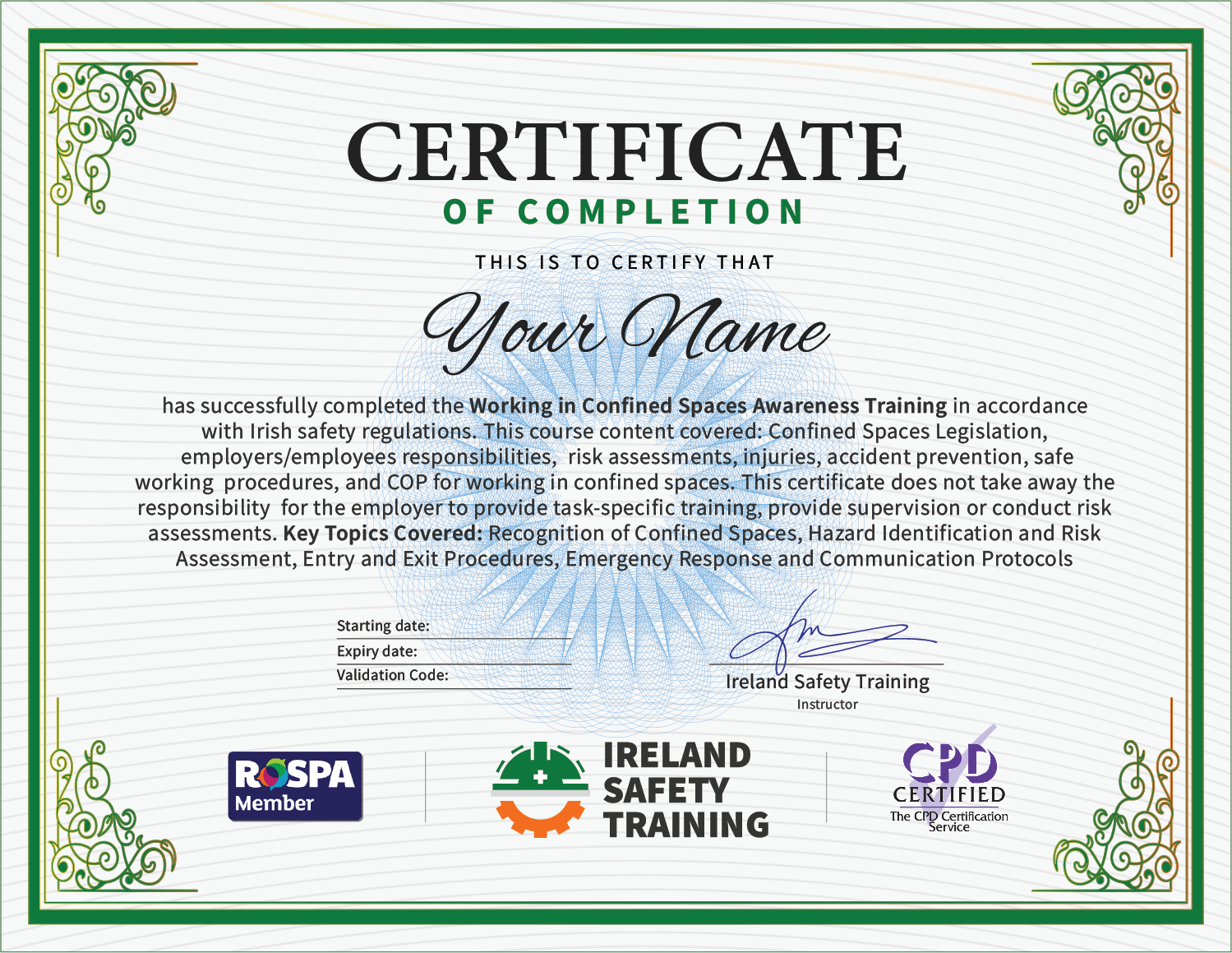
Ireland Safety Training is trusted by 350,000+ learners across Ireland. Our confined space training meets HSA standards and complies with Irish and EU safety legislation. Certificates are accepted by employers across Dublin, Ireland, UK, and Europe.
Our courses are approved by RoSPA (Royal Society for the Prevention of Accidents) and CPD (Continuing Professional Development) Certification Service. Construction companies, utilities including Irish Water and Gas Networks Ireland, manufacturing facilities, and businesses nationwide accept our certification.
Getting certified is simple, fast, and completely online. Whether this is your first Confined Spaces course or a refresher, our friendly platform guides you every step of the way. Over 350,000 learners across Ireland already trust us - and you will too.
Create your free account in seconds. Browse our courses, select the Confined Spaces course, add it to your cart, complete your payment securely, and get instant access to start your training straight away.
Study whenever and wherever it suits you. Our Confined Spaces training includes HD video lessons, clear graphics, and interactive content. Works perfectly on your phone, tablet, or computer - available 24/7 with no deadlines.
When you feel confident, take the online assessment. There is no pressure - you get unlimited retries at no extra cost. Our friendly support team is always here if you need any help along the way.
As soon as you pass, your Confined Spaces certificate is ready to download immediately. Fully recognised by employers across Ireland, the UK, and Europe. Print it, email it, or store it digitally - it is yours forever.
Under Ireland's Safety, Health and Welfare at Work (Confined Spaces) Regulations 2001 (S.I. No. 218 of 2001), a confined space is any place - including a chamber, tank, vat, silo, pit, trench, pipe, sewer, flue, well, or similar space - that is substantially enclosed (though not always entirely) and where there is a reasonably foreseeable risk of serious injury from hazardous substances or conditions within the space, or from the restricted nature of the space itself.
The HSA's Code of Practice for Working in Confined Spaces (2005) provides detailed guidance on identifying confined spaces and managing the risks. A space does not need to be completely enclosed to be classified as a confined space - the key factors are restricted access/egress and the potential for hazardous conditions.
The first principle of confined space safety is avoidance: do not enter a confined space unless absolutely necessary. The hierarchy of control for confined spaces prioritises elimination of entry wherever possible, followed by engineering controls, safe systems of work, and finally personal protective equipment.
| Category | Examples | Common Hazards |
|---|---|---|
| Underground | Manholes, sewers, tunnels, vaults, shafts, pits | Toxic gases (H2S, CH4), oxygen depletion, flooding |
| Storage | Tanks, silos, hoppers, vats, vessels, drums | Engulfment, residual chemicals, oxygen depletion |
| Agricultural | Slurry tanks, grain silos, manure pits, feed storage | H2S from slurry (rapidly fatal), engulfment in grain |
| Industrial | Boilers, furnaces, reaction vessels, ducts, flues | Extreme heat, toxic residue, oxygen depletion |
| Utility | Water treatment tanks, pumping stations, chambers | Toxic gases, biological hazards, electrical risks |
| Marine/Offshore | Ship holds, ballast tanks, cargo spaces, cofferdams | Oxygen depletion, toxic cargo residues, flooding |
| Construction | Excavations, trenches, basements, culverts, caissons | Collapse, flooding, accumulation of gases |
Confined spaces are among the most dangerous workplace environments. According to the HSA (Health and Safety Authority), confined space incidents in Ireland frequently result in fatalities - often multiple fatalities in a single incident, as would-be rescuers enter without proper equipment and become casualties themselves. Understanding confined space hazards is the foundation of every confined space course.
In Ireland, agriculture has the highest workplace fatality rate of any sector. Slurry tanks on farms are confined spaces where hydrogen sulfide (H2S) gas - released during agitation - can reach lethal concentrations within seconds. Multiple family members have died in single slurry tank incidents.
| Hazard | Safe Limit | Danger Level | Effects |
|---|---|---|---|
| Oxygen (O2) | 19.5% - 23.5% | < 19.5% or > 23.5% | Below 16%: impaired judgment, unconsciousness. Below 6%: death in minutes. Above 23.5%: extreme fire risk |
| LEL (Flammable Gas) | < 10% of LEL | > 10% of LEL | Risk of fire or explosion. Methane, petroleum vapours, solvents. No hot work above 1% LEL |
| Hydrogen Sulfide (H2S) | < 5 ppm (TWA) | > 10 ppm | 10 ppm: eye/throat irritation. 100 ppm: olfactory fatigue (can't smell it). 300+ ppm: rapidly fatal |
| Carbon Monoxide (CO) | < 30 ppm (TWA) | > 50 ppm | Headache, dizziness. 400 ppm: life-threatening in 3 hours. 1,200+ ppm: death in minutes. Odourless |
| Ammonia (NH3) | < 25 ppm (TWA) | > 35 ppm | Severe respiratory irritation, chemical burns. Common in agricultural and refrigeration settings |
| Engulfment Risk | Material secured | Loose material present | Grain, sand, water, slurry. Burial or drowning. Rescue extremely difficult once engulfment occurs |
Sources: HSA Code of Practice for Working in Confined Spaces (2005), HSE EH40 Workplace Exposure Limits, OSHA Permissible Exposure Limits. TWA = Time-Weighted Average (8-hour).
Confined space training is a legal requirement in Ireland. Employers must ensure all workers who may enter or work near confined spaces receive adequate training and instruction. The key legislation governing confined space safety in Ireland includes:
Under these regulations, employers must: assess all confined space risks before any entry; avoid entry if reasonably practicable; implement a safe system of work if entry is necessary; ensure adequate training for all workers involved; provide suitable rescue arrangements; and maintain proper records. Failure to comply can result in prosecution, significant fines, and imprisonment.
| Priority | Control Measure | Description |
|---|---|---|
| 1 (Highest) | Elimination | Avoid entry entirely. Complete the work from outside using remote tools, cameras, or long-reach equipment. This is always the preferred option. |
| 2 | Engineering Controls | Forced ventilation, mechanical isolation (LOTO), purging, inerting, continuous atmospheric monitoring systems. |
| 3 | Safe System of Work | Permit to work, atmospheric testing (pre-entry + continuous), competent person supervision, communication systems, time limits. |
| 4 | PPE / RPE | Full-body harness, multi-gas detector, RPE (SCBA or airline BA), tripod and winch retrieval system. PPE is the last resort, not the first. |
| 5 | Emergency Rescue | Pre-planned rescue arrangements. Non-entry rescue preferred. Trained rescue team on standby. Never attempt improvised rescue. |
Safe confined space entry requires clearly defined roles. Every person involved must understand their responsibilities before any entry takes place. Our confined spaces training covers all these roles in detail.
| Role | Responsibilities | Training Required |
|---|---|---|
| Competent Person / Supervisor | Assesses risks, authorises permits to work, ensures controls are in place, verifies atmospheric test results, can cancel entry at any time | Advanced confined space training, risk assessment qualification, site-specific knowledge |
| Entrant | Enters the confined space to perform work. Must follow permit conditions, wear required PPE, maintain communication, exit immediately if conditions change | Practical confined space entry training (hands-on with equipment, RPE fit test, rescue drill) |
| Attendant / Standby Person (Top Man) | Remains outside at all times. Monitors entrant, maintains communication, operates retrieval equipment, raises alarm, prevents unauthorised entry. Must NEVER enter the space | Confined space awareness + attendant duties training, communication procedures, retrieval equipment operation |
| Rescue Team | Pre-designated team trained and equipped for confined space rescue. Non-entry rescue using retrieval lines is always preferred over entry rescue | Specialist confined space rescue training (City & Guilds / EUSR), first aid, RPE use, retrieval systems |
Agriculture has the highest workplace fatality rate of any industry in Ireland. Slurry tanks and pits are confined spaces that present an extreme, immediate danger to life. When slurry is agitated, it releases hydrogen sulfide (H2S) gas - a toxic gas that is rapidly fatal at concentrations above 300 ppm and can reach lethal levels within seconds during agitation.
Multiple fatalities have occurred in Ireland from single slurry tank incidents, often because family members attempted rescue without proper equipment. H2S causes olfactory fatigue at 100 ppm - meaning you lose the ability to smell it precisely when concentrations become dangerous.
Critical rules for slurry tanks: Never enter a slurry tank for any reason. Never lean over a tank opening during agitation. Ensure all tank openings are securely covered. Keep children and animals away during agitation. Agitate only with maximum ventilation. Have an emergency plan and tell someone when you are working near slurry. Grain silos also present engulfment and atmospheric risks - treat them as confined spaces requiring the same level of caution.
The HSA's Farm Safety Code of Practice and specific farm safety campaigns address these risks. This confined spaces course covers agricultural confined space hazards as part of the comprehensive curriculum, including practical guidance on slurry tank safety, grain silo risks, and emergency procedures for agricultural settings.
Answers to the most common questions about our confined space course, certificate validity, legal requirements, and the difference between awareness and entry-level training.
Complete your confined space training in 45 minutes. Instant certificate. CPD & RoSPA accredited. Only €35. Trusted by 350,000+ learners across Ireland.
Start Course Now - €35 (Final Price)